GEN | Lydd (EGMD)
ATC Positions
| RT Callsign | Position Logon | Controller Identifier | Frequency |
|---|---|---|---|
| Lydd Information | EGMD_ATIS | ATIS | 129.230 |
| Lydd Tower | EGMD_TWR | ADC | 119.380 |
| Lydd Approach | EGMD_A_APP | APC | 120.705 |
Note
Lydd is not equipped with radar, so Lydd Approach can only provide a Basic or Procedural Service.
VATSIMism
When Lydd ATC is closed, it is covered top-down in the following priority order:
| Coordination Name | Position Logon | Controller Identifier | Frequency |
|---|---|---|---|
| TC South East | LTC_SE_CTR | TCSE | 120.530 |
| TC South | LTC_S_CTR | TCS | 134.125 |
| TC Bandbox | LTC_CTR | TC | 135.805 |
| AC Dover | LON_D_CTR | LD | 134.905 |
| AC South | LON_S_CTR | LS | 129.430 |
| AC South Central | LON_SC_CTR | LSC | 132.605 |
| AC Bandbox | LON_CTR | L | 127.430 |
Altimeter Setting Procedures
All aircraft shall operate on the Lydd QNH.
The Transition Altitude is 6000 ft.
The Transition Level (TL) and Minimum Stack Level (MSL) at Lydd is determined in accordance with the following table.
| Lydd QNH (hPa) | Transition Level (TL) | Minimum Stack Level (MSL) |
|---|---|---|
| 1032 – 1050 | FL55 | FL65 |
| 1013 – 1031 | FL60 | FL70 |
| 996 – 1012 | FL65 | FL75 |
| 978 – 995 | FL70 | FL80 |
| 960 – 977 | FL75 | FL85 |
| 943 – 959 | FL80 | FL90 |
Note
Holding at ROMTI or GOKAT normally occurs below the Transition Level.
Lydd is situated within the Chatham ASR. Aircraft to the North-West operating beneath the LTMA shall operate on the London QNH and not on an RPS to reduce the risk of controlled airspace infringement.
Info
From here on, unless otherwise specified, vertical references measured in feet are assumed to be altitudes AMSL.
Special Use Airspace
EGR063 Dungeness
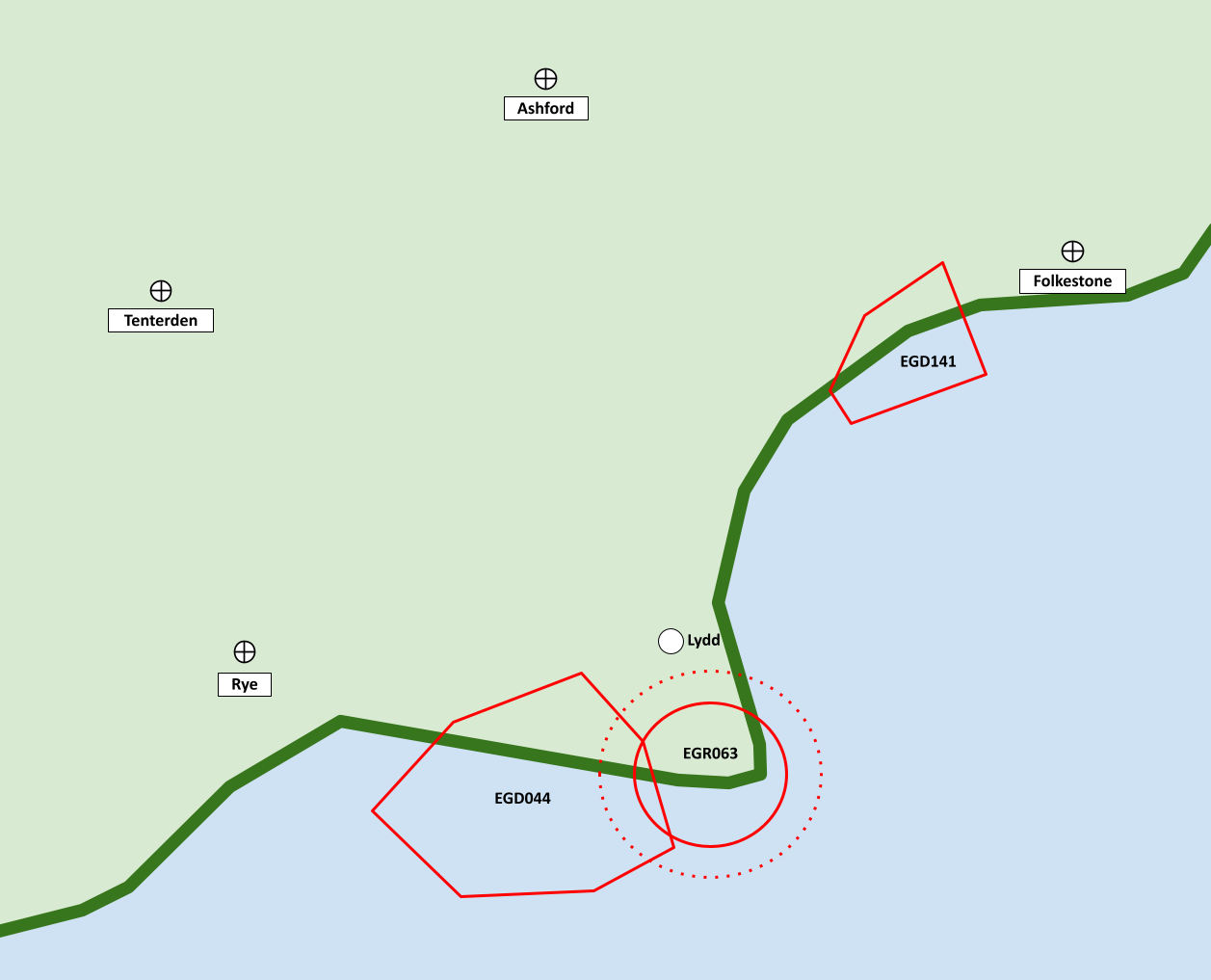
EGR063 is a 2 NM circle centered on 505449N 0005717E (Dungeness Power Station) from the surface to 2000 ft.
Flights are permitted for the purpose of landing or taking off from the landing area at the power station with their permission.
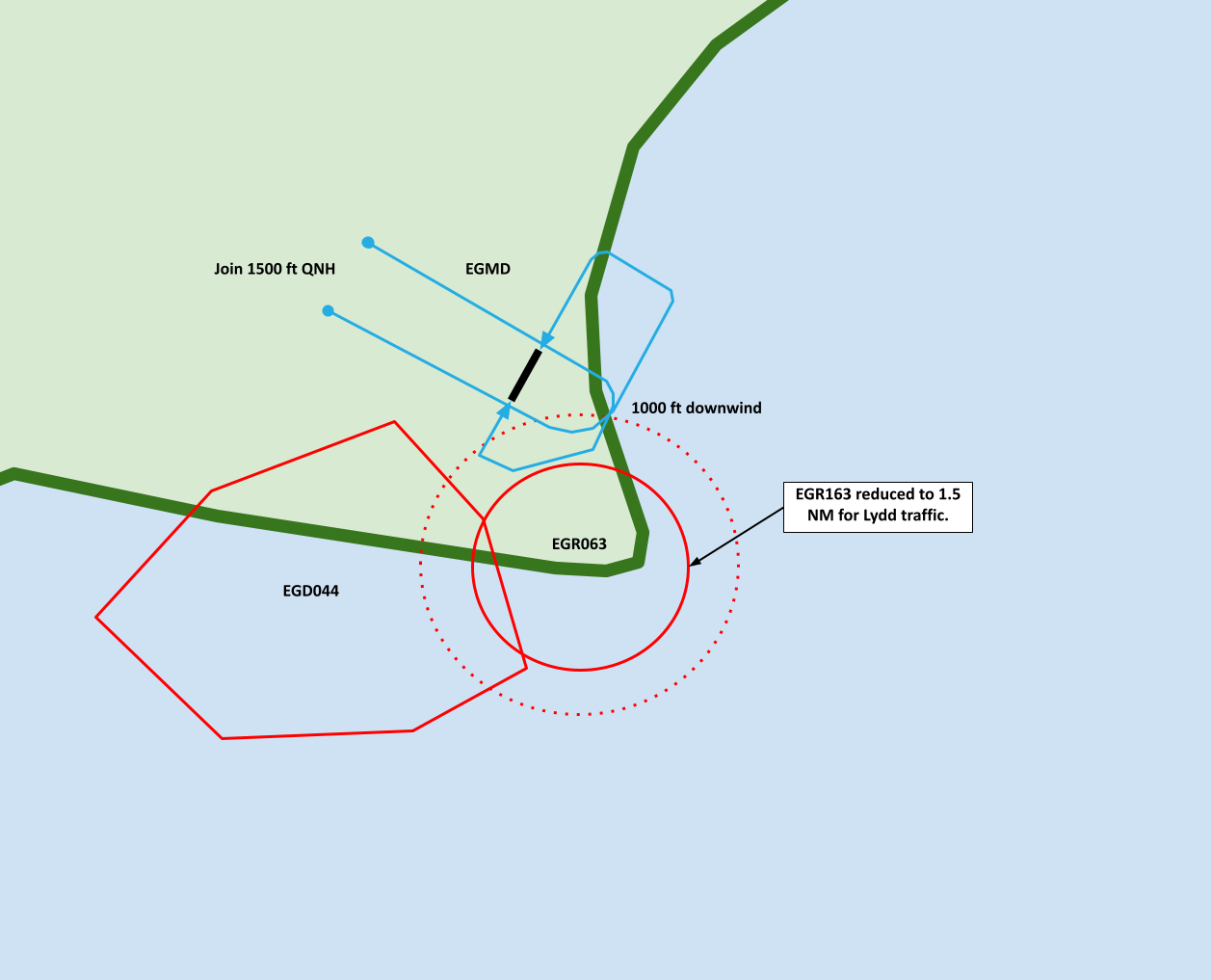
Aircraft in the circuit are permitted to enter up to 0.5 NM within EGR063, reducing the radius to 1.5 NM.
EGD044 Lydd Ranges
EGD044 is situated 1.5 nm to the south and south west of Lydd from the surface to 4000 ft. A SUAAIS is provided by APC and London Information.
EGD141 Hythe Ranges
EGD141 is situated 5.5 nm to the north east of Lydd from the surface to 3200 ft. A SUAAIS is provided by APC and London Information.
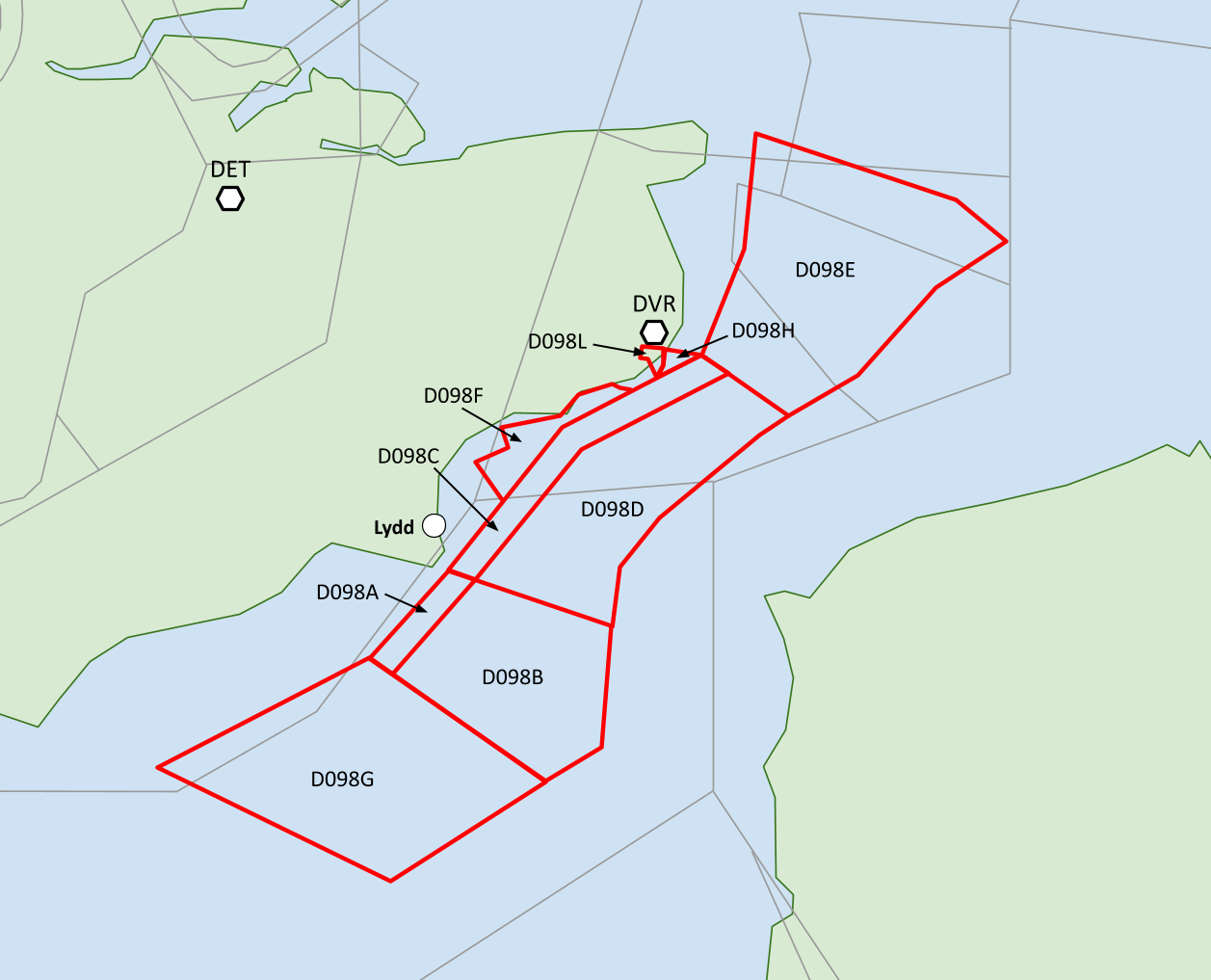
EGD098 English Channel Temporary Danger Area Complex
EGD098 A-H and L are located within the English Channel. A SUAAIS is provided by APC and London Information.
| Danger Area | Vertical Limits |
|---|---|
| D098A, D098B, D098C, D098D |
SFC-1500 ft |
| D098E | SFC-2500 ft |
| D098G | SFC-2000 ft |
| D098F, D098H | SFC-800 ft |
| D098L | SFC-900 ft |
Noise Abatement Procedures
The following noise abatement procedures apply to all aircraft taking off:
Runway 03: Climb straight ahead to at least 500 ft; or until passing upwind end of the runway, whichever is later, before turning right or left as instructed by ATC.
Runway 21: Climb straight ahead to at least 500 ft; or until passing upwind end of the runway, whichever is later, before turning left or right as instructed by ATC. Aircraft turning left are to maintain a track which will ensure they remain at least 1.5 NM clear of the Dungeness Power Station. If EGD044 is active, all aircraft are to remain clear.
Runways and Instrument Approach Procedures
Runway 21 is the preferred runway if the tailwind component is less than 5 knots and the runway surface is dry.
An offset CAT I ILS is available to Runway 21 only, along with NDB and RNP approaches. Runway 03 only has an RNP approach.
Warning
Runway 03 is not available for arrivals when danger area EGD044 is active.
Note
Aircraft may land on Runway 21 from an IAP when Runway 03 is in use, if they are willing to accept a tailwind, instead of circling to land or joining the visual circuit.
Low Visibility Procedures
Lydd is not equipped for CAT II/III operations. However to safeguard CAT I ILS operations, LVP are enforced when the reported MET visibility or RVR is less than 2000 m and expected to deteriorate, and/or the cloud ceiling is less than 300 ft and expected to deteriorate. Pilots shall be informed if LVP are not in place when visibility reduces to 1000 m or less, and/or the cloud ceiling is less than 200 ft.
Where available, RVR values shall be passed to arriving aircraft with landing clearance and to departing aircraft on start-up when LVP are in place.
If the visibility drops to 500 metres or less, departing aircraft shall be instructed to report commencing taxi, commencing take-off, and airborne. Arriving aircraft shall be instructed to report landed, runway vacated, and when on stand.
VATSIMism
Our SMR view replicates a theoretical SMR view, and Lydd is a purely visual tower. As such, in poor visibility conditions, unlike the real world, we can 'see' the aircraft when that would not otherwise be possible.
During LVP:
- Conditional clearances must not be issued,
- Any helicopter movements will be to/from the runway,
- Only 2 aircraft will be allowed to move in the aerodrome at any time,
- Aircraft shall not be permitted to enter the runway or taxi via A or D once an inbound aircraft has reported established on the final approach track/localiser.
VFR Procedures
Fixed-wing circuits are to the east of the aerodrome, right hand for Runway 03 and left hand for Runway 21. The circuit altitude for fixed-wing aircraft is 1500 ft.
Pilots are responsible for their own separation from all danger and restricted areas.
Inbound VFR aircraft should make their initial call for joining instructions at Rye (west), Tenterden (north west), Ashford (north), M20/Folkestone (north east), or 10 NM to Lydd if approaching from the sea. All inbound aircraft will then be instructed to report 4 NM to Lydd.
Aircraft arriving from the west or north will, unless otherwise instructed, join overhead at 1500 ft, descend crosswind, and turn downwind at 1000 ft. Aircraft are not permitted to descend deadside. The phrase "Standard Overhead Join" shall not be used as it is not a standard overhead join.
Aircraft arriving from the east, southeast, and south will anticipate instructions to join the circuit on the downwind or base leg, subject to traffic.
ADC shall notify APC when the visual circuit is in use, including the number of aircraft within it.
Helicopter Procedures
- The helicopter circuit is on the opposite side to the fixed-wing circuit, left hand for Runway 03, right hand for Runway 21, at 1000 ft.
- Helicopters must obtain clearance to cross the runway.
- All helicopter movements shall utilise the runway for landings or take-offs.
- Small helicopters (e.g. R44, B06, EC145), will air taxi to/from Apron B as directed by ATC.
- Large helicopters shall ground taxi to reduce downwash to taxiing or parked aircraft.
Note
When the runway is blocked, coastguard helicopters may still be permitted to depart.
Local SSR Code Procedures
| Mode A Code(s) | Allocation |
|---|---|
7066 |
Lydd Conspicuity Code (VFR) |
7067 |
Lydd Conspicuity Code (IFR) |