Warning
This version 2 of the new format! Please let us know how we did here.
Warning
This quick reference updates automatically - any text in
East Midlands (EGNX) | Quick Reference
General
LVP
LVP
Enforced when: IRVR or Met. Visibility is 1500 m or less or cloud ceiling (BKN+) 300 ft or less.
Aircraft will use the following holding points:
-
27: Departures at A2, Arrivals vacate via G2
-
09: Departures at G2, Arrivals vacate via A2
Warning
When LVP are in force the following holding points are closed: H1, H2, M1, M2, S1, S2, W1, W2
GMC/GMP
Departure Prenotes
Departure Prenotes
| Departure | GMP Coord. | STUP Pre-Note |
|---|---|---|
| Non-Std IFR/VFR/SVFR | ||
| To EGBB/BE | TC M | RAD 1 & BB RAD |
| To LTMA or EGHI/EGHH | Receiving TC | TC M |
| To EGCC/GP/NM | PC SE | PC SE |
Taxiway Restrictions
Taxiway Restrictions
The maintenance areas and Kilo apron are uncontrolled aprons, i.e. movements beyond MA, M4, M5 and K1 are at the discretion of the pilot
Phraseology should be as follows:
Inbound Traffic
Taxi holding point MA/M4/M5/K1 via …, then at your own discretion.
Outbound Traffic
Taxi at your own discretion holding point MA/M4/M5/K1, then taxi...
- Twy MA max size B350.
- Must hold on A abeam Q/T when aircraft parking on stand 24.
- Must hold at A4/A6 when aircraft parking on stands 5/6/21/23/24 or 30.
- Cannot user Twy C (must push onto Twy Q).
- Twy D only in use for arriving / departing east apron.
- Code E + MD11 cannot use Twys M or U.
- Cannot use Twy J south of holding point J.
- Twy V max size B748.
- Twy N only in use for access to stand 42.
- No separation from other code E on east apron - can only use stands 73L / 83W on this apron.
- Cannot use Twy A while another code F uses runway.
- Cannot use Twy A between A3 and A4 while code E (or MD11) is on D.
- Cannot taxi past a runway holding point where another aircraft is holding
Flights to Birmingham (EGBB)
Flights to Birmingham (EGBB)
Routing: SAPCO Y53 DTY L10 HON
Departure: SAPCO departure, with instruction to stop climb at altitude 5000ft
Radiotelephony
BAW123 cleared to Birmingham, SAPCO 1P departure, stop climb altitude 5000 ft, squawk [code]
Prenote: RAD 1 & BB RAD
Delay Absorption: TC M
RYR100T Procedures
RYR100T Procedures
The callsign RYR100T is used by Ryanair when conducting base training at East Midlands.
The clearance to operate in the circuit will be issued on stand by GMC, but must first be approved by AIR and APC. The clearance is issued as follows:
Radiotelephony
“Ryanair 100T, cleared [left-hand/right-hand] circuits, VFR, at altitude 2000 ft, QNHXXXX, squawk 4570.”
Any other operator conducting base training shall be allocated a discrete local squawk.
Note
Prior to departure, ADC must obtain a release for RYR100T.
For ease, the callsign may be abbreviated to “Ryanair one hundred tango” provided there will be no ambiguity or callsign confusion.
Level Capping (Not exhaustive)
Level Capping (Not exhaustive)
| Destination | Max RFL |
|---|---|
| EGBB/BE | 80 |
| EGLL/KK/SS/GW/WU | 150 |
| Rest of LTMA | 190 |
| EGAA/AC/AE | 280 |
| EGCC/GP/NR | 100 |
| EGNS | 190 |
| EGSH | 190 |
| EHRD | 210 |
| EIDW/CK/NN | 280 |
| LFPG/PB/PT/OB/OP | 290 |
SIDs
SIDs
| SID | Airborne QSY | Initial Climb | Notes |
|---|---|---|---|
| TNT 2N | PC SE (134.430) | 6000ft | |
| SAPCO 1N | TC M (121.030) | FL090 | Route to DTY: SAPCO DCT DTY / SAPCO Y53 DTY |
| SIDs | Airborne QSY | Initial Climb | Notes |
|---|---|---|---|
| TNT 3P | RAD 1 (126.180) | 6000ft | |
| POL 2P | RAD 1 (126.180) | 6000ft | UK Time: 0700 - 2200. Alternative: TNT |
| SAPCO 1P | RAD 1 (126.180) | FL090 | Route to DTY: SAPCO DCT DTY / SAPCO Y53 DTY |
Top-Down Order
Top-Down Order
| Coordination Name | Position Logon | Controller Identifier | Frequency |
|---|---|---|---|
| AIR | EGNX_TWR | NXT | 124.005 |
| INT | EGNX_APP | NXR | 126.180 |
| TC Welin | LTC_MW_CTR | TCMW | 130.925 |
| TC Midlands | LTC_M_CTR | TCM | 121.030 |
| AC Daventry Low | LON_ML_CTR | LML | 133.975 |
| AC Daventry North | LON_ME_CTR | LME | 127.880 |
| AC Daventry | LON_M_CTR | LM | 120.025 |
| AC Central | LON_C_CTR | LC | 127.105 |
| AC South Central | LON_SC_CTR | LSC | 132.605 |
| AC Bandbox | LON_CTR | L | 127.830 |
AIR
Departure Pre-Notes/Releases
Departure Pre-Notes/Releases
| Departure | GMP Coord. | STUP Pre-Note | Release (AIR) |
|---|---|---|---|
| All runway 09 SID departures | RAD 1 | ||
| Non-Std IFR/VFR/SVFR | RAD 1 | ||
| After RWY change | RAD 1 | ||
| To EGBB/BE | TC M | RAD 1 & BB RAD | RAD 1 |
| To LTMA or EGHI/EGHH | Receiving TC | TC M | TC M |
| To EGCC/GP/NM | PC SE | PC SE | PC SE |
Handoff / Release Orders
Handoff / Release Orders
| Order | Frequencies | ||||||||||||||||||||||||||||||||||||||||||||||||||||||||||||||||||||||||
|---|---|---|---|---|---|---|---|---|---|---|---|---|---|---|---|---|---|---|---|---|---|---|---|---|---|---|---|---|---|---|---|---|---|---|---|---|---|---|---|---|---|---|---|---|---|---|---|---|---|---|---|---|---|---|---|---|---|---|---|---|---|---|---|---|---|---|---|---|---|---|---|---|---|
Non standard / non-airways departure = 09 South Order |
|
Wake Turbulence Separation (Seconds)
Wake Turbulence Separation (Seconds)
| Lead→ ↓Follow |
S | H | M | S | L |
|---|---|---|---|---|---|
| S | - | - | - | - | - |
| H | 120 | 4 NM | - | - | - |
| M | 180 | 120 | - | - | - |
| S | 180 | 120 | - | - | - |
| L | 180 | 120 | 120 | 120 | - |
Wake Turbulence Seperation Notes
- When the leading aircraft is conducting a full length take-off, and the following from an intersection take-off, add 1 minute to the minimum seperation time
- When seperation is by distance, the time equivalent is also permissable.
Note
Add 60 seconds for a departure from an intersection following one from full length.
Route Separation
Route Separation
| Lead→ ↓Follow |
TNT PC SE (134.430) |
SAPCO TC M (121.030) |
|---|---|---|
| TNT PC SE (134.430) |
2 | 1 |
| SAPCO TC M (121.030) |
1 | 2 |
| Lead→ ↓Follow |
TNT RAD 1 (126.180) |
POL RAD 1 (126.180) |
SAPCO RAD 1 (126.180) |
|---|---|---|---|
| TNT RAD 1 (126.180) |
2 | 2 | 1 |
| POL RAD 1 (126.180) |
2 | 2 | 1 |
| SAPCO RAD 1 (126.180) |
1 | 1 | 2 |
Speed Separation Groups
Speed Separation Groups
| Group 4 | Group 3 | Group 2 | Group 1 |
|---|---|---|---|
| All jet aircraft except: - Those in Group 3 - Concorde - Military fast jets |
BAE146/Avro RJ CL35/CL60 CRJ1/2/7/9/X B328/J328 DH8D E135/145 E50P/55P P180 SB20 Citations except: C56X/680/68A/700/750 |
ATR variants DH8A/B/C F50 JS31/32/41 King Air variants PC12 SF34 SW3/4 TBM7/8/9 |
BN2P/T C208 DA62 DHC6 E110 |
Speed Separation Notes
- The basic separation interval (2 minutes) is applied between types in the same group (or where the following aircraft is one group slower)
- An additional 1 minute is added for each successive group when the following aircraft is faster (where the resulting timed interval is excessive, the controller may coordinate an early release)
- The basic interval may be reduced by 1 minute when the following aircraft is two or more groups slower (however, the controller must account for wake turbulence separation)
- Types not in the speed table (and the subsequent aircraft) are subject to release from the appropriate radar controller.
VFR Procedures
VFR Procedures
Standard circuit clearance (not mandatory but advised):
| Runway | Direction | Altitude | RYR100T Altitude |
|---|---|---|---|
| 09 | Left hand | 1300 ft | 2000ft |
| 27 | Right hand | 1300 ft | 2000ft |
GMC may clear VFR/SVFR on standard routes without coordination.
Standard clearance VFR/SVFR via (see diagram below):
- Long Eaton Lane, remaining East of the M1 Motorway
- Shepshed Lane, remaining West of the M1 Motorway
Not above altitude 2000 ft VFR, East Midlands QNH, local squawk (4550-4567).
All VFR non-standard zone exit clearances shall be coordinated with FIN by GMP.
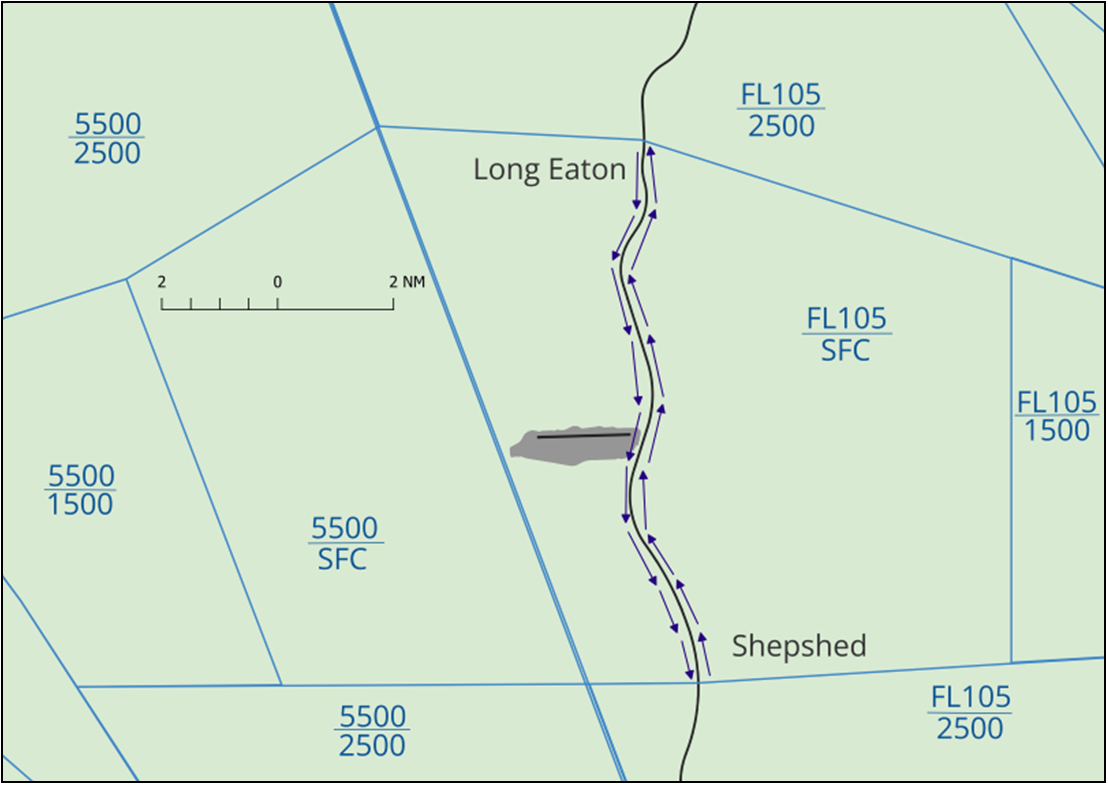
East Midlands Standard VFR Routes
APC
Hold Details
Hold Details
| Name | Axis | Direction | Holding Levels | Leg Time / Length | Speed |
|---|---|---|---|---|---|
| ROKUP | 292° | RIGHT hand | MSL - FL140 | 1 minute | Max 220 kts IAS |
| PIGOT | 185° | LEFT hand | MSL≥FL80 - FL150 | 5.5 NM | Max 220 kts IAS |
| EME | 268° | LEFT hand | 3000 ft - 6000 ft | 1 minute | Max 210 kts IAS |
| EMW | 088° | RIGHT hand | 3000 ft - 5000 ft | 1 minute | Max 210 kts IAS |
Wake Turbulence Arrival Separation (NM)
Wake Turbulence Arrival Separation (NM)
| Lead→ ↓Follow |
J | H | UM | LM | S |
|---|---|---|---|---|---|
| J | - | - | - | - | - |
| H | 5 | 4 | - | - | - |
| UM | 7 | 5 | 3 | - | - |
| LM | 7 | 5 | 4 | - | - |
| S | 7 | 6 | 4 | 3 | 3 |
| L | 8 | 7 | 6 | 5 | 4 |
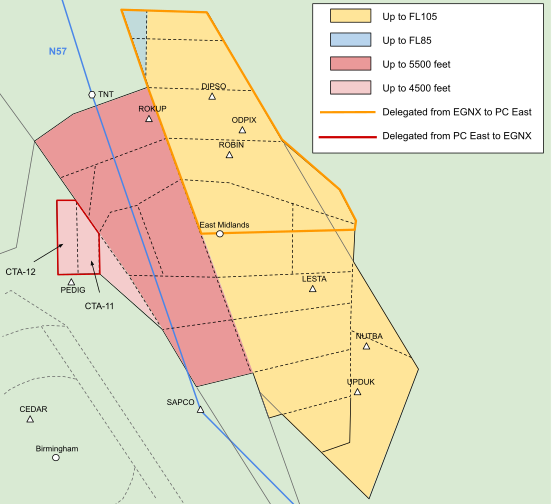
Release Conditions
Release Conditions
Inbounds are RFD to MSL, then further when east of the eastern edge of Daventry CTA-3.
Inbounds are released for right hand turns only until within the confines of the East Midlands CTA.
Inbounds on Runway 09 must not be vectored back west into East Midlands CTA-6 until they are at altitude 5000 ft or below.
Inbounds are RFD to FL080, then further within the confines of the East Midlands CTA.
Inbounds must not be vectored west of the 360 degree track off VELAG until within the confines of the East Midlands CTA and at or below FL100.
| Runway | Condition |
|---|---|
| 27 | Aircraft shall not be vectored west of the eastern edge of Daventry CTA-3 unless at or below 5000 ft. |
| 09 | Aircraft must not be vectored west of the eastern edge of Daventry CTA-3 until they are at or below FL70 |
RYR100T Circuit Procedures
RYR100T Circuit Procedures
When RYR100T is operating in the circuit the following procedures can be used in order to achieve sufficient spacing from inbound traffic:
-
ADC can extend the circuit straight ahead after departure and downwind to fit behind other traffic on final, however, use caution to keep the circuit traffic inside controlled airspace. Due to the early turn after departure, it is recommended to plan ahead and instruct RYR100T to continue straight ahead while they are still on final.
-
APC can issue delay vectors to allow ADC to fit the RYR100T in ahead or keep the vectors ‘tight’ to keep the inbound ILS traffic ahead of the RYR100T.
-
APC can issue instructions to ADC to pass to RYR100T in order to vector them along with the other IFR arrivals.
-
When there is a stream of inbound aircraft, it may be necessary for RYR100T to land and taxi back to the holding point to absorb some delay on the ground, or if they are already airborne, they may need to be directed to a holding facility (EME/EMW/PIGOT/ROKUP).
-
Due to tight airspace RYR100T cannot be instructed to orbit as this may take them outside controlled airspace.
Note
Prior to departure, ADC must obtain a release for RYR100T.
For ease, the callsign may be abbreviated to “Ryanair one hundred tango” provided there will be no ambiguity or callsign confusion.
Squawks
Squawks
| APC | RYR100T | Conspicuity | Listening | Costock Helicopters (CTK) |
|---|---|---|---|---|
4550-4567 |
4570 |
4571 |
4572 |
4573 |
Transition Level & MSL
Transition Level & MSL
| EGNX QNH | TL | MSL |
|---|---|---|
| 1050-1060 | 60 | 70 |
| 1032-1049 | 65 | 70 |
| 1013-1031 | 70 | 70 |
| 995-1012 | 75 | 80 |
| 977-994 | 80 | 80 |
| 959-976 | 85 | 90 |
| 940-958 | 90 | 90 |