Introduction
It can sometimes be confusing knowing who (or indeed if) you need to call a controller when flying on VATSIM. This page is a guide of when you do, when you do not, and who you should call when flying in the UK. Remember, it's always safer to call than not, so if you're still not sure after reading this guide, make contact with a controller and they should be able to help.
The Top-down Principle
You should hopefully already be familiar with VATSIM's 'top-down' principle of operation, but if not read this  top-down guide. Departures should always contact the 'lowest' position that covers their airport first, escalating through top-down as required. There is a tool at the bottom of this page to show who is the currently active top-down controller.
Dynamic Visualisation
Tools exist to help visualise active controllers and the areas they cover in real time.
VATSIM Radar is the one we recommend using. It is worth noting that the lateral area of coverage is dependant on the level ('altitude') you are at. To view coverage at a specific level, ensure VATGlasses mode is enabled with the toggle in the bottom right of the page and use the slider right of the page to adjust the level:

VATGlasses Controls on VATSIM Radar
Alternatively, after clicking the 'Connect VATSIM' button in the top right, you can 'Track' your aircraft's current level to see active ATC at that level. But remember if you are climbing or descending, this will not alert you to airspace you may be about to enter.
For example, the 'T' in the below image shows Gatwick Tower (EGKK_TWR) online, with the area they are responsible for at low level. The 'A' shows the ATIS is also available. You can hover over these letters or click on the shaded areas to get more information including their active frequency.
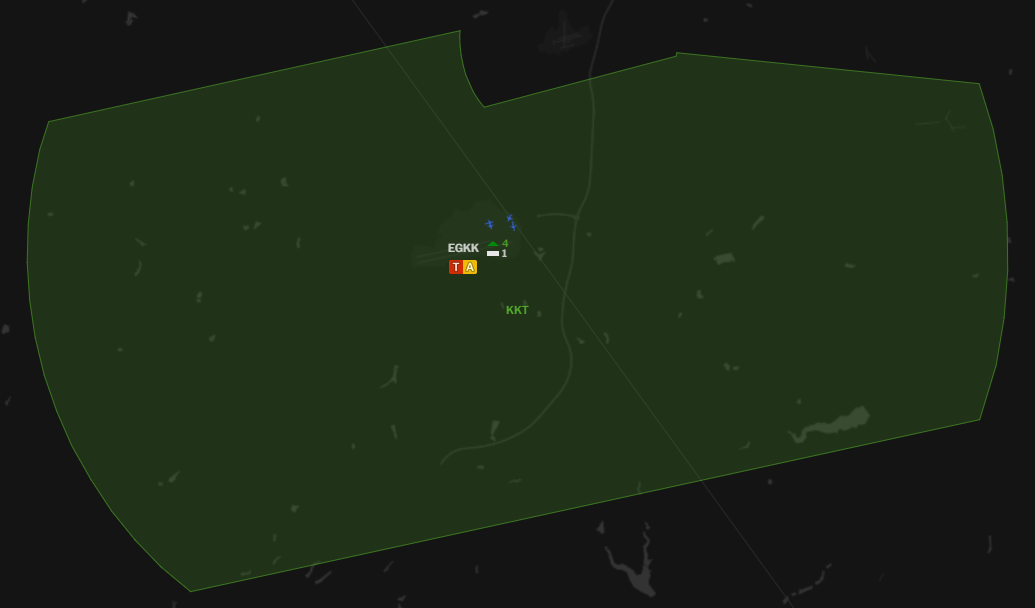
Gatwick Tower Online on VATSIM Radar
Area Sectors
Not all sectors you see lit up on VATSIM Radar will necessarily be relevant to your type of flight...
Information Positions
EGTT_I_CTR and EGPX_I_CTR are "London Information" and "Scottish Information" respectively.
They are non-radar units, and only able to provide a Basic Service to traffic operating outside of controlled airspace (UK FIS OCAS). Unless you are operating outside controlled airspace, and there is no 'better' unit for you to be in contact with, do not contact these controllers, as they will be unable to help you. They typically only work VFR aircraft or GA IFR aircraft operating OCAS.
Military _CTRs
EGVV_CTR is "Swanwick Control".
It exists primarily to support military traffic, and will cover military aerodromes top-down in the absence of a local unit. While Swanwick might sometimes (subject to workload) provide aircraft OCAS with a service (typically only above FL100), it is rare for commercial traffic to need to contact them.
Civilian _CTRs
LON_ and LTC_ positions are referred to as "London Control".
SCO_, SCL_ and MAN_ positions are referred to as "Scottish Control".
These other area sectors are civilian sectors in the UK.
In general terms, LTC, SCL and MAN sectors are 'terminal' controllers operating at lower levels, and LON and SCO are 'enroute' controllers, covering higher up.
Vatsimism
These controllers are part of the top-down principle on VATSIM, so you might need to contact them from your departure stand if there is no more local/lower ATC. Make sure you check who you need to call using VATSIM Radar or the tool below.
Top-down of UK Aerodromes
Not all aerodromes in the UK are covered under the top-down principle. Specifically, those without 'full ATC' - i.e. AFIS and AGCS aerodromes, are not covered top-down. All full-ATC aerodromes (those with a permanent Tower or Approach unit) will be covered top-down by someone, but they might not always be online. The tool below helps you know who to call should there ever be a problem with VATSIM Radar.
Information
Some Approach/Radar units cover multiple airports in the absence of local Aerodrome Control (TWR/GND/DEL).
Warning
In times of high workload, the level of top-down cover may be reduced, but you must always make contact in the first instance.
Enter your departure airport ICAO below to find the current top-down controller's frequency: