Cross the Pond Controller Brief - 26E
-
Controllers should, where possible, arrive 5-10 minutes before their rostered slot to observe the frequency.
-
Controllers must use the handover aide-memoires to ensure critical information like non-standard information, is not missed. It is advised to monitor the frequency and controller for a few minutes after the handover to be available to answer any questions.
-
Strict adherence to flow measures is mandatory - #flow-measures in discord will provide accurate information on active flow measures, please take note of when flow measures become active etc.
-
Advice and guidance on flow control can be found here. Please review before the start of the event.
-
A spreadsheet containing all active flow measures can be found at
 this link. A review of Aerodrome Flow Control is advised.
 -
CDM will be in use throughout the entire event; adherence to the slots is mandatory to protect en route sectors. UK_FMP or UK_A_FMP will be available to assist with any questions or queries regarding slots and CDM usage.
ADC
AIR
-
AIR deps should plan for a reduced departure rate and continuously monitor the ATM for arrivals on the non-duty runway as these may not be individually coordinated during busy periods.
-
AIR deps should be mindful of active flow measures when creating their sequence. There is likely to be heavy MDIs / slots to adhere to. It is more important that you stick to these (and not overwhelm area controllers) that achieve a high rate of departures.
-
Air controllers shall prioritise keeping traffic moving away from the runway holds. Once seen to be slow / vacating, issue an instruction to turn left or right onto A/B as traffic requires. Do not handoff to GMC before the aircraft has made the turn, and cleared the exit, as issuing a frequency change may cause the aircraft to come to a stop.
-
Go-arounds can be very costly to the arrival rate and at the wrong time can have a significant knock-on effect all the way back to Area sectors. AIR controllers should therefore keep significant focus to ensure the runway is clear. This should include encouraging pilots to vacate and continue moving past the stop bars as well as not lining departures up in “small” gaps. If a go-around is issued with a departure lined up, consider telling the departure to vacate if there is an arrival to that runway inside 6NM.
-
In the case of a go around, AIR arrivals shall initiate coordination with AIR deps to make a plan, before coordinating with TC Heathrow.
-
AIR Controllers are reminded they may use anticipated separation to issue timely landing clearances. A landing clearance may be issued once the preceding aircraft is seen to turn towards a runway exit and it is expected to clear the runway edge prior to the following aircraft crossing the threshold. A 'land after' instruction may only be issued during daylight hours.
GMC
-
Aircraft may be landing on the non-duty runway. Therefore, GMC should use B for outbound flights to keep A free for aircraft to vacate. Aircraft may be returned to A as they near the departure end to help you sequence aircraft towards AIR.
-
GMC should pay attention to the order in which they are presenting traffic to AIR deps, keeping in mind flow measures, wake and route separation.
-
GMC must not keep aircraft on stand longer than dictated by their workload. If a queue forms waiting for pushback, the planner controller shall be informed with the reason for the delay.
-
GMC controllers shall not change UKCP stands for ‘convenience’ as pilots with hoppies functionality in their aircraft will likely plan for the stand provisionally assigned to them, which in some cases may mean they plan for a left/right turn onto A/B.
PLN
-
Planner controllers should take into account active / upcoming flow measures, position on the aerodrome, and SID groups when deciding who to push. Try not to operate on first come first serve.
-
Should departure delays result in significant aircraft waiting on stand, preventing arriving aircraft from being able to park, consider pushing aircraft and creating a queue towards the holding points, or quieter areas of the airport.
GMP
GMP must pay close attention to ECFMP restrictions relating to level capping, and mandatory routes.
APC
General
TC Heathrow controllers need to ensure a continuous even flow of traffic from the BNN and OCK stacks and prioritise these against other stacks as these are where the event traffic will be held, the easiest way to do this is to consider time in hold for aircraft in the stacks and consider this in your landing order. It is expected to be an easterly configuration on the day. You must use the UKCP hold manager for yourself and other controllers to see the delay.
You can expect to peak at 34 arrivals per hour, this allows for 1 or 2 mistakes but you need to be on top of your game, keep it standard and don’t do anything funny, know the standard headings and if it isn’t working then change it by 5-10 degrees for the wind, use the TopSky MET > Upper Winds menu to see the expected wind.
TEAM should be used as described in the vMATS (max 6 aircraft per hour, none of this permanent “TEAMing” we sometimes see during events, more like permanent parallel approaches at that point!), there shouldn’t be such a delay where it’s needed, and typically the extra rate isn’t achieved anyways on VATSIM.
INT (Both)
INT’s can expect to take traffic from FL120 - MSL in the stack from TC.
Hard speed control for all aircraft off the stack will be needed, remember that it is common when flying a heading aircraft will typically automatically cancel any constraints and accelerate back to 250 knots.
Typically initial headings should follow the edge of the RMA but not all. If you need familiarisation with the headings then see the table below:
| Stack | Westerlies Track | Westerlies Distance | Easterlies Track | Easterlies Distance |
|---|---|---|---|---|
| LAM | 270° | 30 - 35 NM | 265° | 55 NM |
| BNN | 120° | 30 - 35 NM | 230° or 180° | 30 NM |
| BIG | 265° | 30 - 35 NM | 275° | 50 NM |
| OCK | 075° | 30 - 35 NM | 280° | 30 NM |
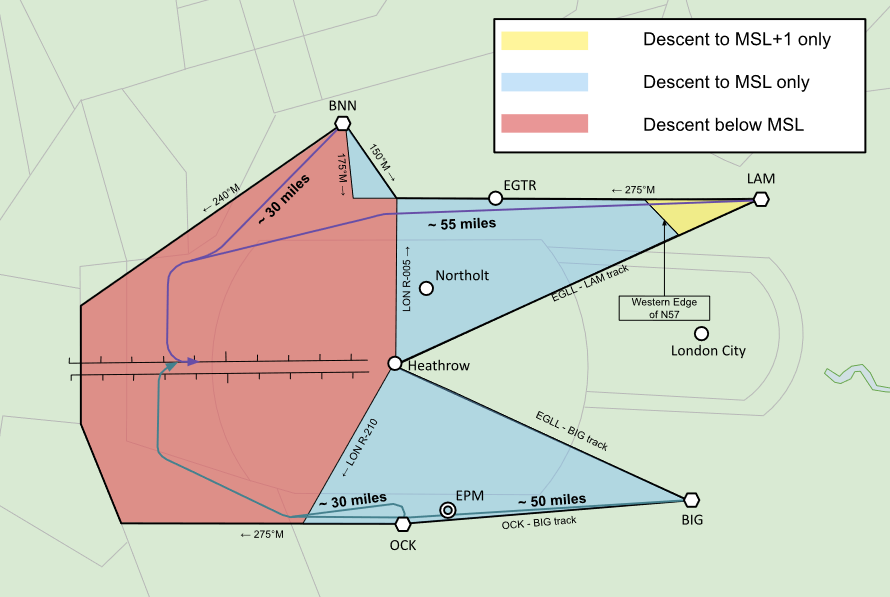
The track miles should also help guide who to take off the stack when counting the miles.
On Westerlies from LAM and BNN you can use dog legs to extend the distance from touchdown, and you can do the same from all stacks on easterlies. This technique is important to utilise so that the precise amount of miles required is achieved.
| Delay tactic | Miles Gained |
|---|---|
| Dog Leg | 5 - 10 NM |
| Orbit | 10 NM |
| Complete Hold | 15 - 20 NM |
If on westerlies on turn from initial heading from stack to the downwind, if there is a strong wind on downwind when aircraft can balloon around the corner, consider minimum clean or slower only if needed.
Once the aircraft starts the turn (don’t wait for the turn to complete) and descent is seen (again only need 1 radar return), transfer to FIN without delay!
Typically transfer to FIN will be descending to 4000 ft, however if vertical separation is required aircraft can be transferred at 5000 ft and 6000 ft.
INT N and APC SUP
As APC Supervisor (or INT N when APC Supervisor is not available), it is your role to be the master approach controller, you relay the landing order to INT’s and are overall responsible for ensuring a smooth flow of arrivals. As it will be very busy, you should use the count the miles technique, this simply means counting back from the aircraft 20 NM from touchdown and working your way backwards in 5, then figure out who’s best when you get to 30, 35, 40, 45 NM to fill the rest of the order.
If unsure then you can review the Counting the Miles slideshow or watch the Count the miles tutorial video.
Don’t control by proxy, e.g. don’t tell other INT’s the headings to use, instead just communicate the order quickly and simply, for example: “My BAW12G from BNN and then your VIR365S from OCK.”
INT S
As INT S you’re responsible for the south side of RMA and BIG/OCK stacks. While the main responsibility of the landing order is for INT N, INT S should still point out or make suggestions if absolutely needed and should also count their own miles so that aircraft arrive at the point required.
DO NOT vector aircraft off stacks without INT N confirming the plan, they may be calculating and a random aircraft off the stack can change that and they have to recount.
FIN
As FIN you are responsible for taking aircraft from downwind on both sides and merging them onto the approach. This is one of the most demanding positions in terms of focus, a big gap on the ILS can have knock-on effects further down, so reduce distractions and ensure that the spacing is a consistent 4 NM, aiming for 5 NM when a medium follows a heavy generally. We typically don’t want to compress spacing closer than 4 NM as on VATSIM slow vacating traffic and slight differences in weather injected into simulators could cause unnecessary go arounds, 4 NM spacing will allow for a satisfactory landing rate, reduced spacing lower than 4 NM may lead to unnecessary go arounds which will actually reduce the landing rate.
You don’t necessarily have to follow the order the INT controllers have discussed themselves as this usually won’t make a difference to aircraft further down the line.
Keep headings standard for the most part, 90 degree perpendicular base leg and 30 degree intercept angles and only deviate if absolutely necessary, this will keep your base area clean and not chaotic. If there is a strong wind consider adjusting the headings you use to achieve the desired track. Same with speed, 180 knots in the base area and then when desired spacing is achieved, 160 knots until 4 DME (5 DME for an A388)
You can use differences in speed on the final approach to +/- 0.5 NM, for example leaving the lead aircraft until 8 NM on 180 knots and then slowing to 160 knots until 4 DME and the following aircraft gets 160 knots until 4 DME early will slightly increase the spacing between the two aircraft if it’s slightly tighter than wanted, however consider knock on effects for aircraft behind.
Area
General
This controller brief is to be used and adhered to by all controllers controlling En-route positions during the Cross the Pond event. If there is a conflict between local documents and this brief, the brief will take priority within the duration of the event.
For coordination, some sectors will be much busier than others. Make sure to:
-
Be present in Teamspeak and be using vacs for coordination
-
Keep it short and to the point
-
Use electronic coordination for less urgent requests
-
Consider workload of adjacent controllers
Warning
Please ensure that your controller pack and sector file is updated to 2026/04a, as the previous version introduced some bugs which have been fixed in the patched version.
Under GCAP, if you can’t provide full top-down due to workload, then you can terminate it as required. Ideally, if required, a spare controller can split further to even out the workload.
When traffic rates are mentioned, this is only for event traffic and is an estimate; rates may be higher or lower.
The VATCAN Bookings plugin will be in use for the event. Although it is not necessary for us on an eastbound event, the event code is included for those wishing to use it: Xzir5
As always with CTP, we are expecting to be busy and have limited resources. Any ad-hoc arrivals are very welcome.
Try to actively assess both your current workload and incoming traffic throughout your time controlling. If you are getting too busy or can predict an overload, contact the area coordinator as soon as possible for assistance. The earlier you can notify the coordinator, the better chance they have of finding a solution before you become overloaded.
Feedback
After each controlling session, please take the time to fill in this feedback form here.
Scottish AC
Grampian
Covering Grampian
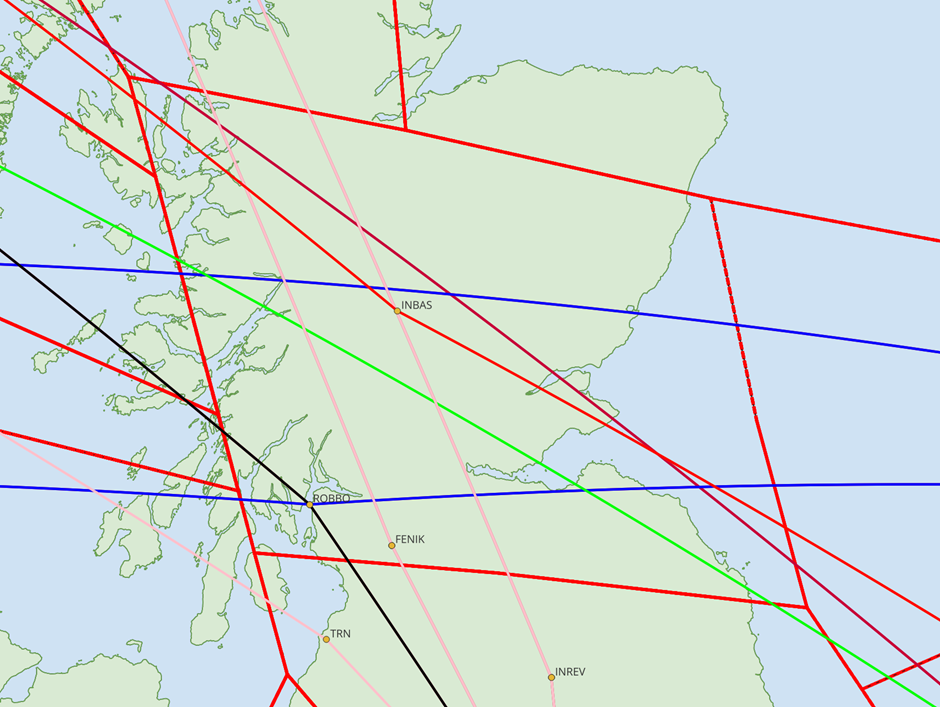
Grampian (SCO_GRP_CTR) is expected to be the busiest. Please see the Scottish Temporary Instruction. Expect around 56 aircraft per hour and many crossings, so planning and coordination will be required to resolve conflicts. Keep an eye out for notified traffic and stay zoomed out to see incoming traffic.
ScAC North
Covering Moray + Hebrides
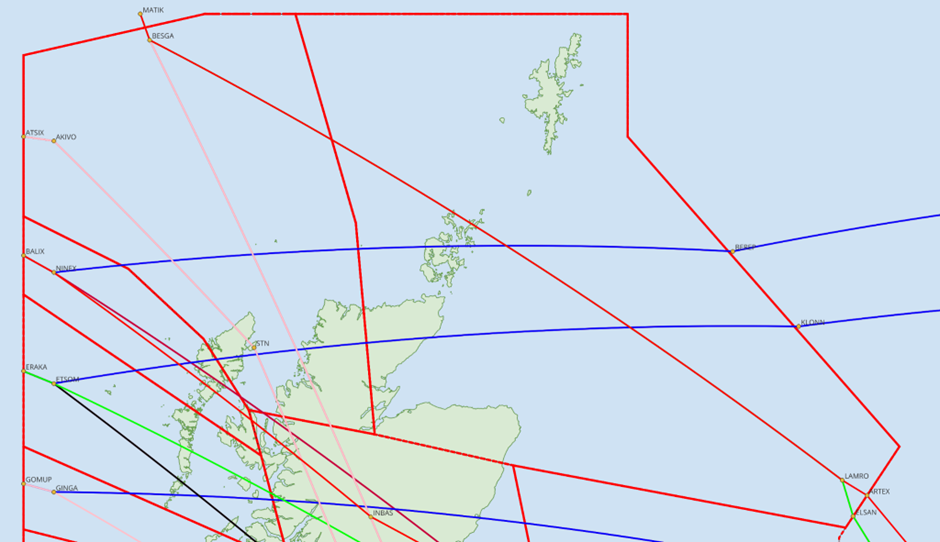
ScAC North (SCO_N_CTR) expects 49 aircraft per hour. You’ll need to watch for traffic from ScAC West that may cross traffic just within the sector boundary, so it may require early coordination/intervention to solve. Expect to stream some arrivals into Oslo, not expecting the stream to be completed, but at least started with Mach numbers applied.
ScAC West
Covering Rathlin + Central + Antrim
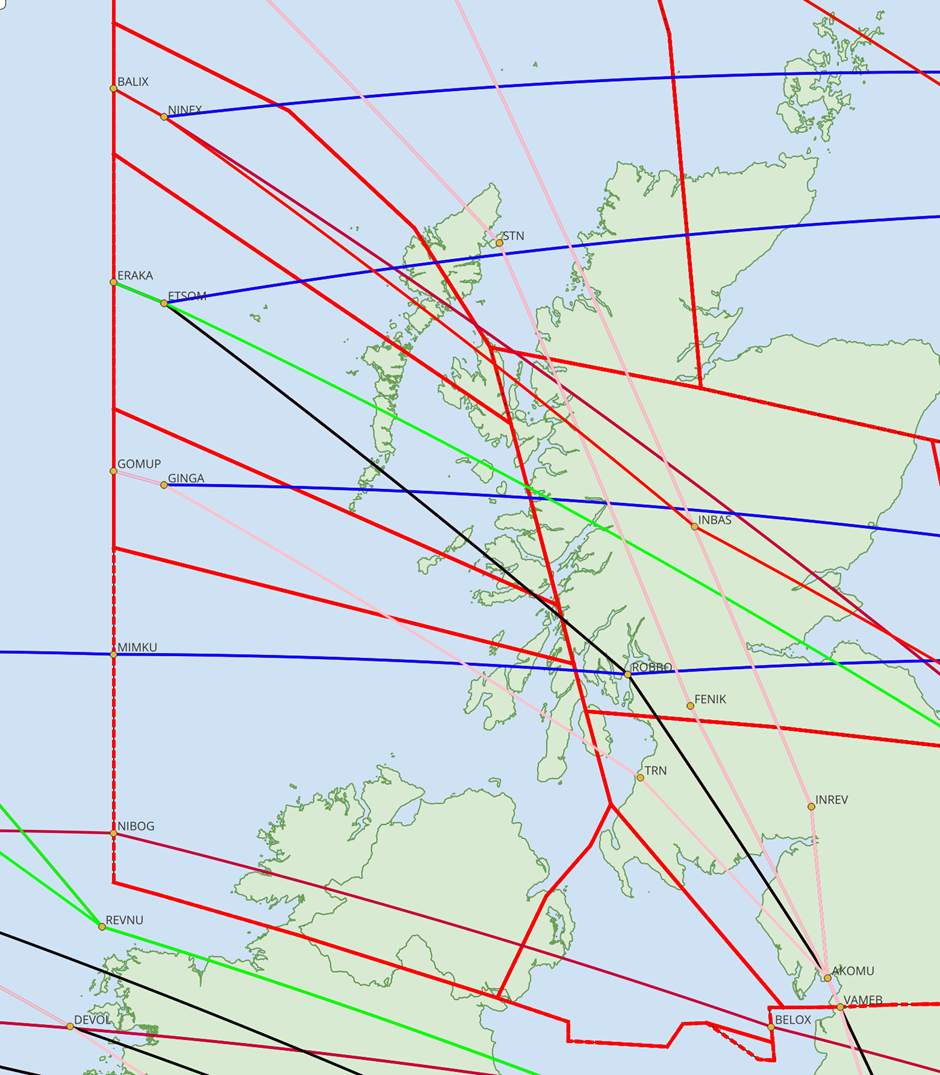
ScAC West (SCO_W_CTR) is expecting around 40 aircraft per hour, with a couple crossing, but most occur outside the sector, inside of Grampian. Watch for traffic within ScAC North and Grampian, and if they don’t coordinate with you to solve a conflict, try to be proactive and get it solved before it becomes a problem.
ScAC South
Covering Tyne, Humber and Borders
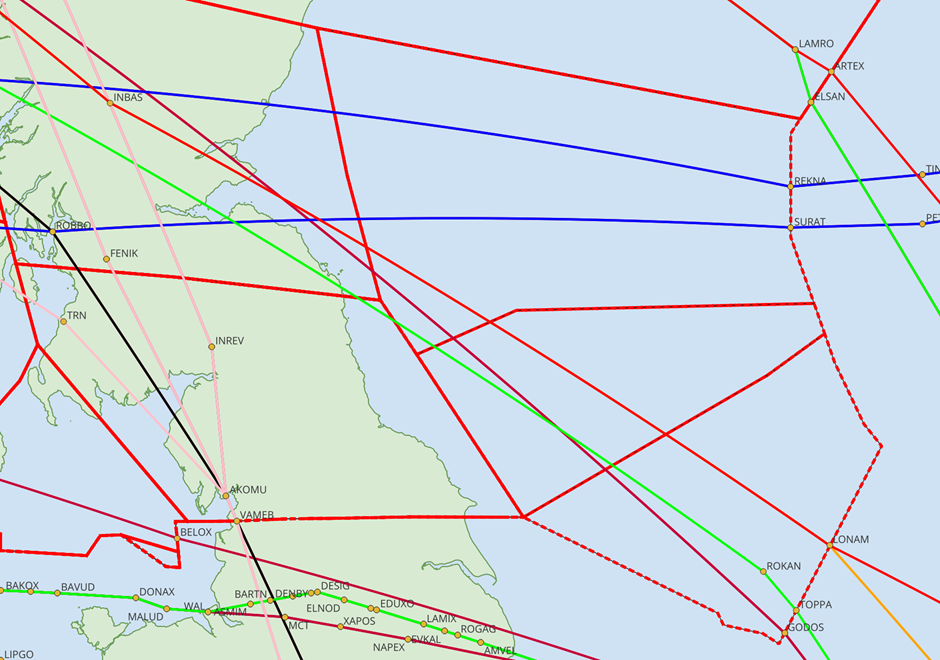
ScAC South (SCO_S_CTR) expects 40 aircraft per hour Traffic via REKNA/SURAT to EKDK to be transferred at even levels to ease crossing in their sector.
Borders
Either covered by West Borders (SCO_WB_CTR) or South (SCO_S_CTR)
Borders can expect 17 aircraft total to require streaming into AKOMU. The Heathrow inbound must be max FL330 at AKOMU to reduce complexity in Lakes.
London AC
AC Bandbox (Clacton + North Sea)
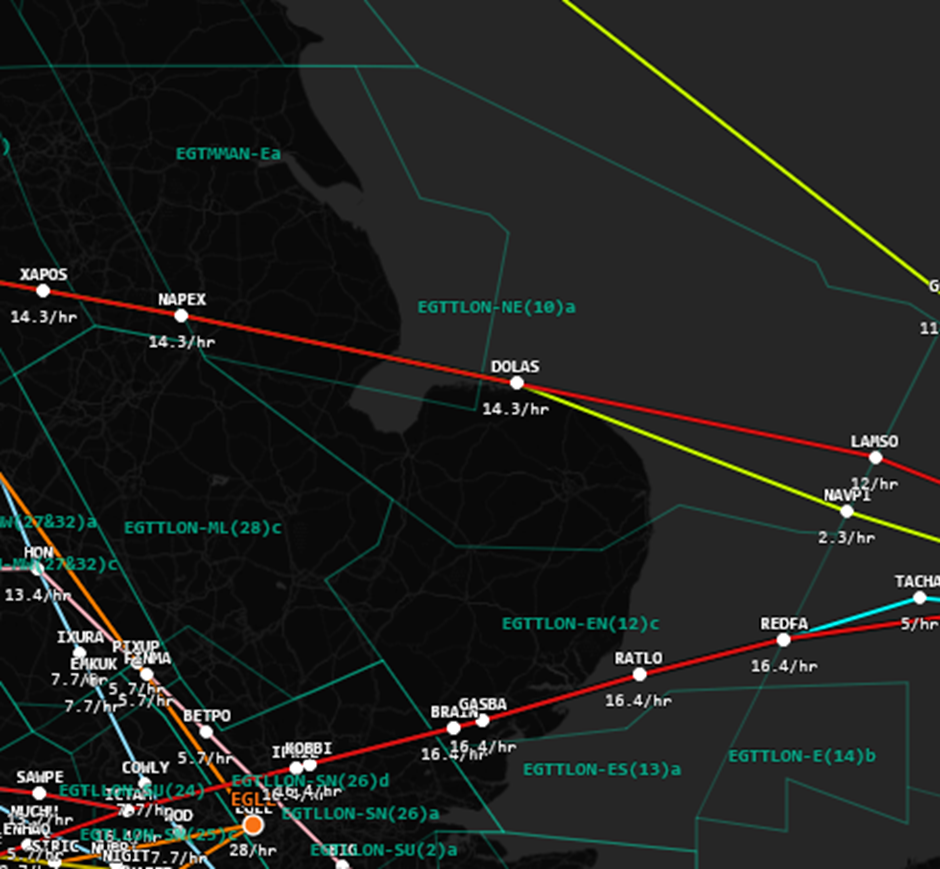
Clacton and North Sea (LON_CTR) is expecting 30 aircraft per hour, will need to do some streaming to Amsterdam via REDFA, FL230 and FL240 are available at REDFA as normal, stream should be started, but doesn’t need to be complete.
Lakes
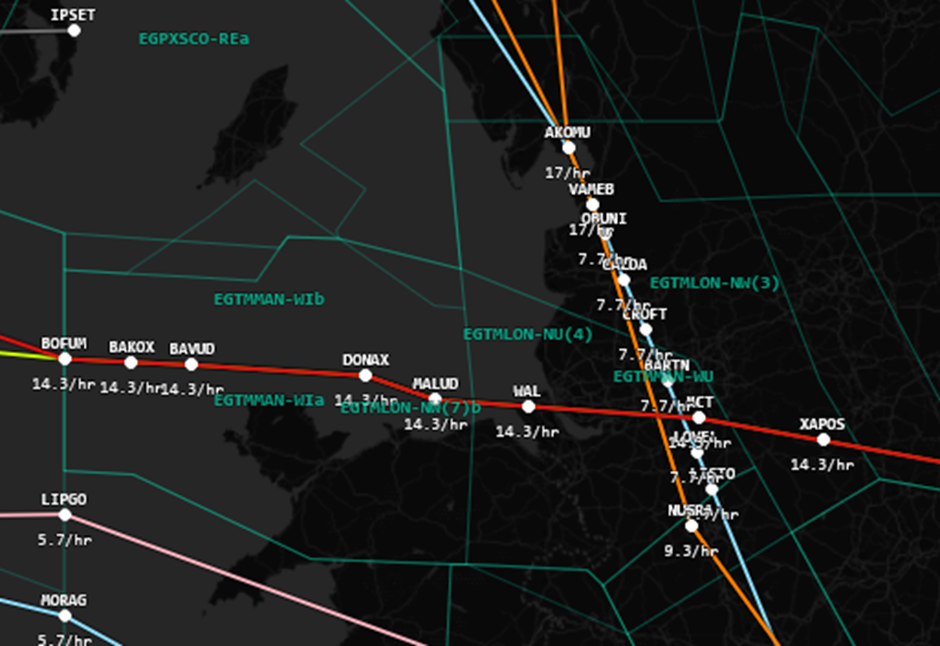
Lakes (LON_NW_CTR) expects 31 aircraft per hour. Expect Heathrow inbounds via AKOMU to be FL330 or below to reduce complexity.
Daventry
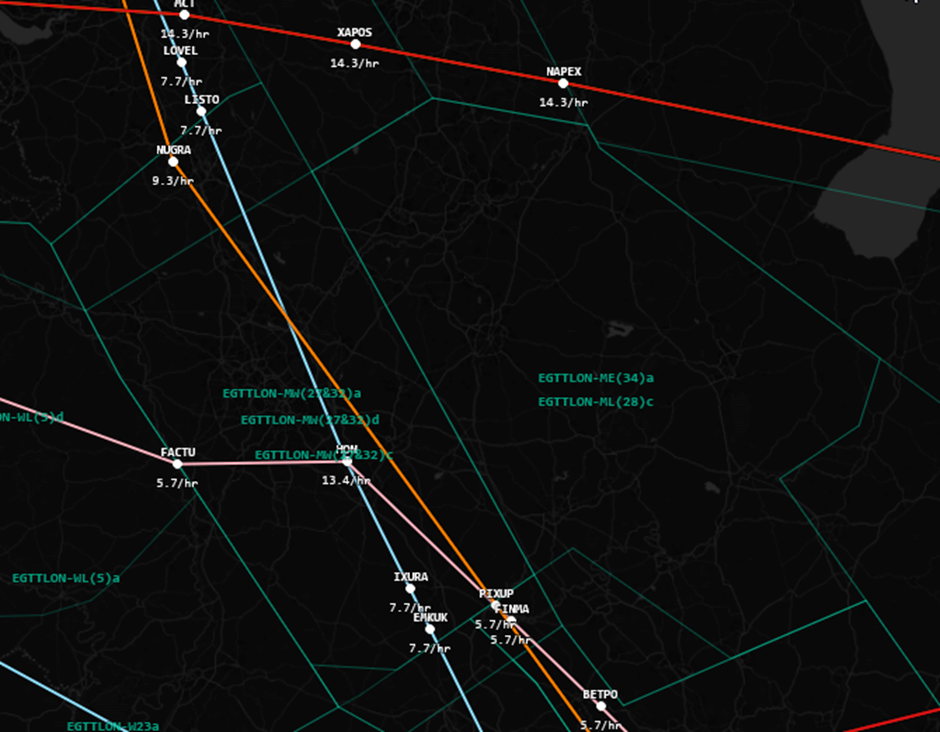
Daventry (LON_M_CTR) expects 23 aircraft per hour. Will be covering TC Midlands as well as TC North West, unless a spare controller shows up so streaming into Heathrow will be required. En route holding is preferred to take place at HON if required. There is no suitable STAR stack swap, so WEZKO can be used to hold as a last-minute procedure.
Note: If instructed by the GS or LUS, Paris inbounds are to be presented to AC South max Paris inbounds max FL300 by EMKUK to skip LUS.
Berry Head
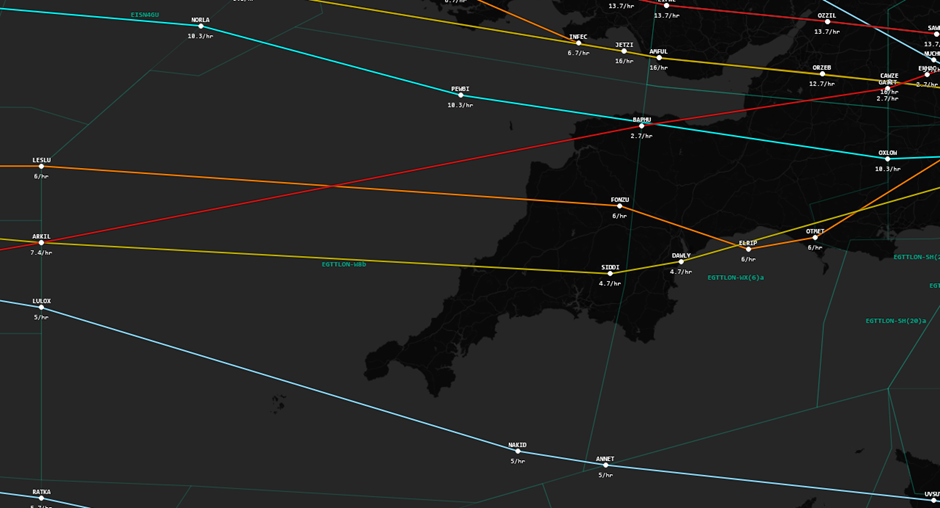
Berry Head (LON_WH_CTR) expects 29 aircraft per hour. Please see the West (BCN & BHD) Temporary Instruction. Planning with Shannon and AC Worthing is a must.
Brecon
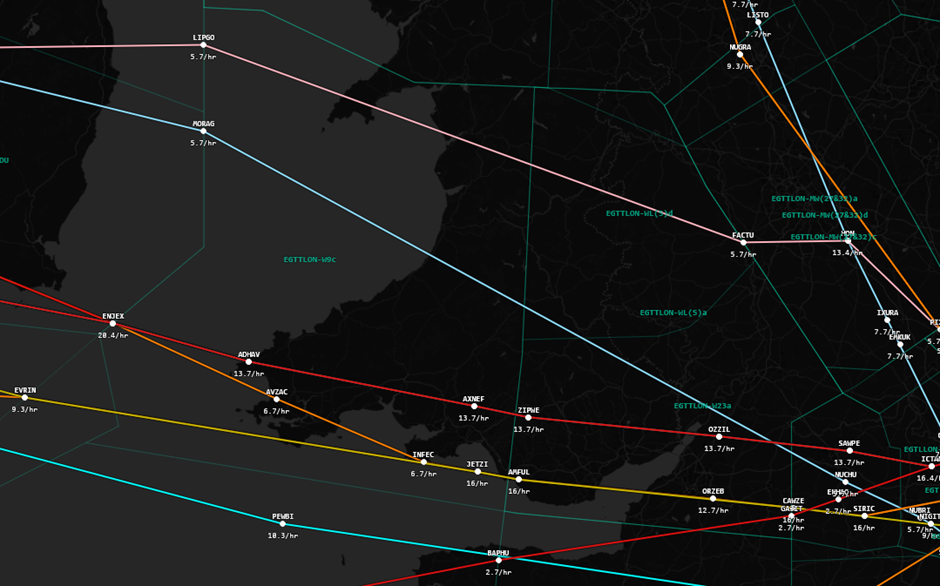
Brecon (LON_WB_CTR) expects 43 aircraft per hour. Please see the West (BCN & BHD) Temporary Instruction. TC South will notify Brecon if en-route holding is required, which occurs at a waypoint named ORZEB, which is approximately 20 NM west of SIRIC, so it is provided to the aircraft before the start of the STAR.
Note: If instructed by the GS or LUS, Paris inbounds are to be presented to AC South max FL300 level 15 before NUCHU to skip LUS.
LUS
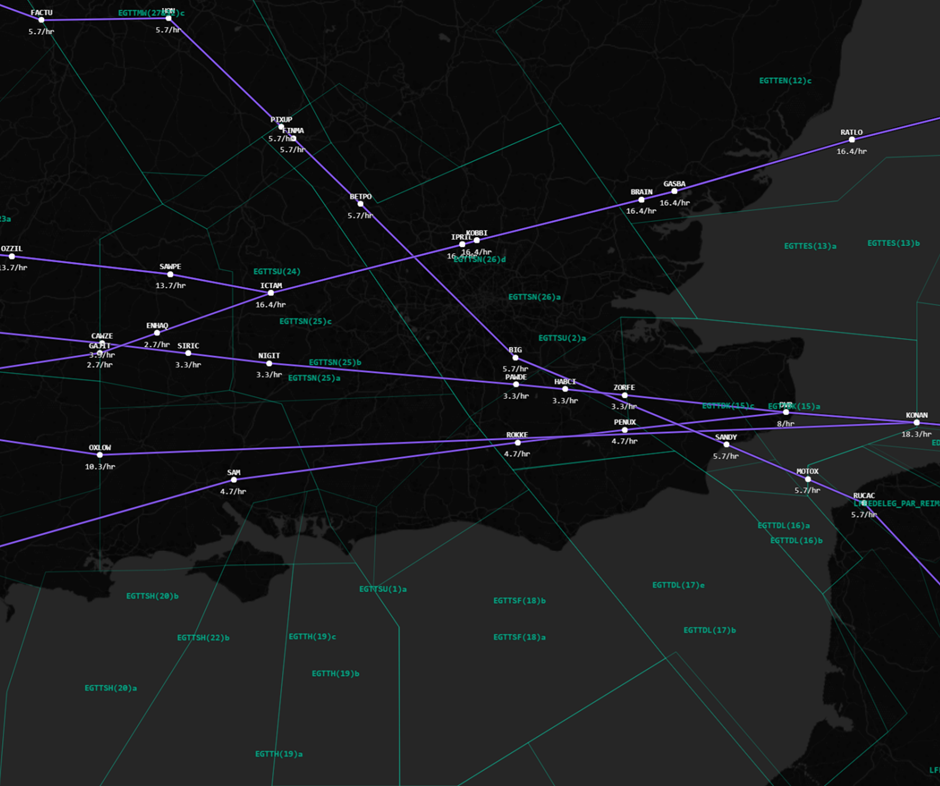
LUS (LON_SU_CTR) expects 40 aircraft per hour. Please see the South (LUS) Temporary Instruction. A lot of crossings will happen in the sector, so planning and requesting changes to the NFL and XFL may be required.
The image and aircraft count does not include LFPG inbounds. If Brecon and Daventry are instructed to do so, LFPG inbounds can be excluded from LUS by being descended to FL300 and transferred to AC South.
AC South
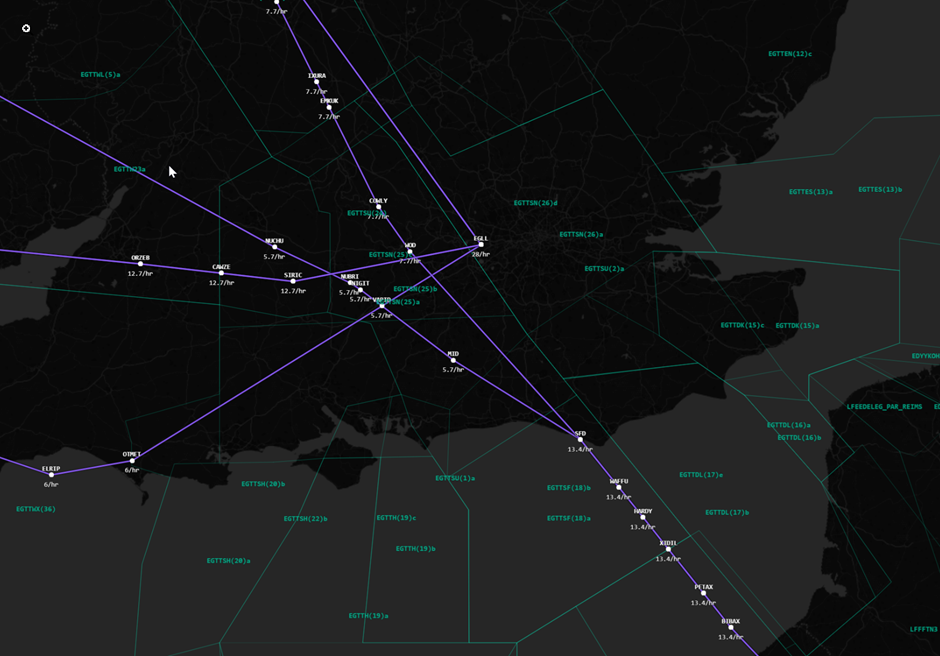
AC South (LON_S_CTR) expects 32 aircraft per hour. Expect Paris inbound to enter the sector at FL300 from the Daventry and West LAG. Paris TP can take traffic at XIDIL between FL240 and FL260; streaming needs to be started, but doesn’t need to be completed.
London TC
TC South
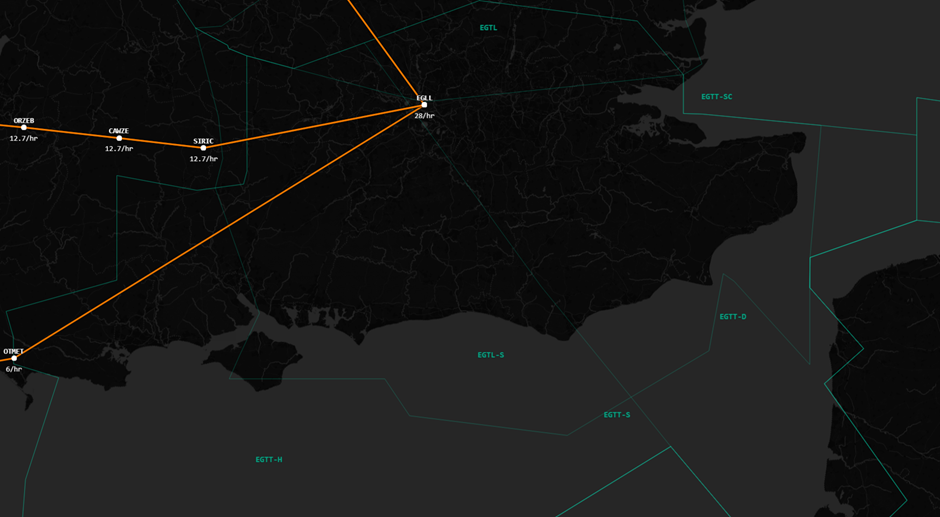
TC South (LTC_S_CTR) expects 19 aircraft per hour. It will take Heathrow arrivals via SIRIC; the en-route takes place before the STAR, so early notification of en-route holding would be best if capable. Also, stack swaps exist to move OCK traffic to BIG via OCK 1Z arrival.